
Logistics optimization is becoming more complex: multi-hop routing, diverse transportation modes, SKU-level requirements, service constraints, and constantly shifting supply-demand conditions — leaving many organizations stitching together multiple tools, custom code, and external solvers to try to keep up. We think there's an easier route…
Kinetica's Multiple Supply Demand Optimization (MSDO) solver is a native, SQL-driven engine that computes optimal routing and allocation across complex, multi-modal supply chains — matching supplies to demands while honoring constraints such as transport modes, capacities, penalties, priorities, and detailed item specifications.
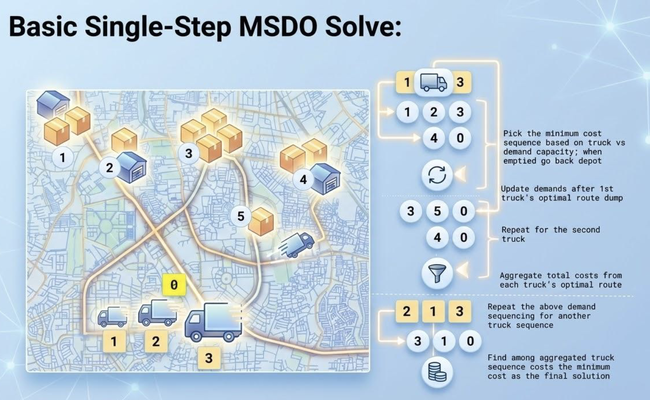
Classic MSDO focused on solving the optimal path from supply to demand in a single step.
In this article we'll discuss recent updates including multi-step optimization and specification-aware matching, that bring Kinetica's hybrid OLAP/Graph closer to becoming a complete, end-to-end logistics solver — capable of modeling and executing complex multi-hop logistics flows through a single, concise SQL statement inside the database.
No more separate optimization engines. No external orchestration layers. No custom Python pipelines — routing, constraints, specification matching, and even multi-step optimization — all created/executed in a single platform.
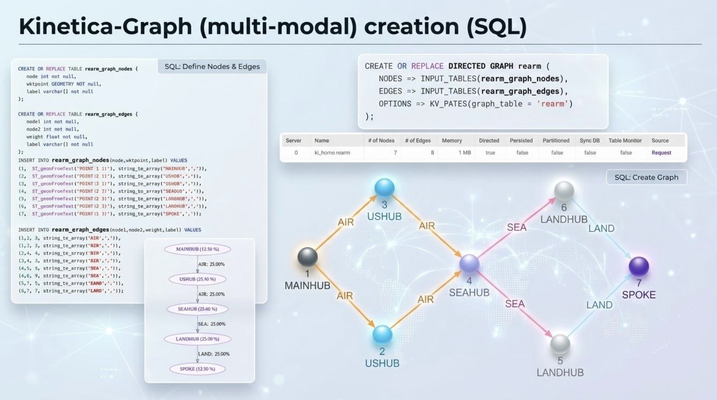
MSDO's multi-modal logistics graph is defined entirely in SQL modeling nodes, edges, and transport modes so complex networks can be built, updated, and optimized directly inside Kinetica DB.
1. Multi-Step MSDO: Optimizing Entire Supply Chains, Not Just Single Routes
The new multi-step MSDO logic fundamentally extends MSDO from simple routing to holistic supply-chain optimization.
- It identifies optimal sub-source → sub-demand transitions.
- Chains them together into full multi-hop delivery paths.
- Treats hubs as dynamic suppliers and consumers which can be updated with streaming data.
- Incorporates replenishment cycles naturally, not just outbound delivery.
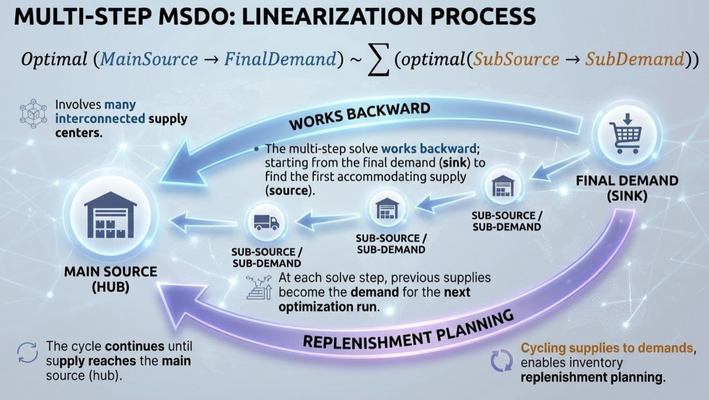
Kinetica's multi-step MSDO works backward from final demand to source, chaining optimal sub-routes into a complete end-to-end plan that naturally supports multi-hop routing and inventory replenishment.
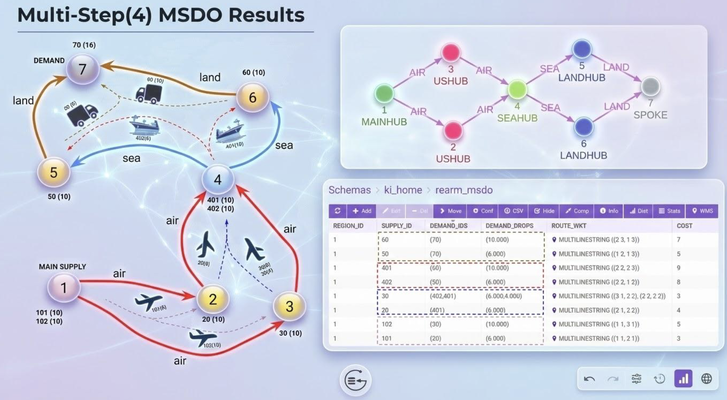
This multi-step MSDO result illustrates how Kinetica stitches together optimal air, sea, and land routes across multiple hubs, producing a complete end-to-end logistics plan directly from a single SQL optimization.
In other words, it models real-world logistics end-to-end rather than just point-to-point paths.
2. Specification-Based Matching: Logistics That Understands the Product
Modern logistics isn't just "how many units need to go where?" It's also "which units can actually go where?"
Kinetica's enhanced solver now supports supply and demand specifications, for multi Step MSDO meaning goods with specific labels like:
- Fragile
- Refrigerated
- Hazard class
- Food-grade
- Oversized
- Special handling requirements
Now products with specific shipping considerations are required to meet the exact DEMAND_SPECS to be eligible for routing — an essential feature for any realistic logistics engine.
Again: no complex logic outside the database. The SQL statement incorporates all specifications, constraints, and solution parameters.
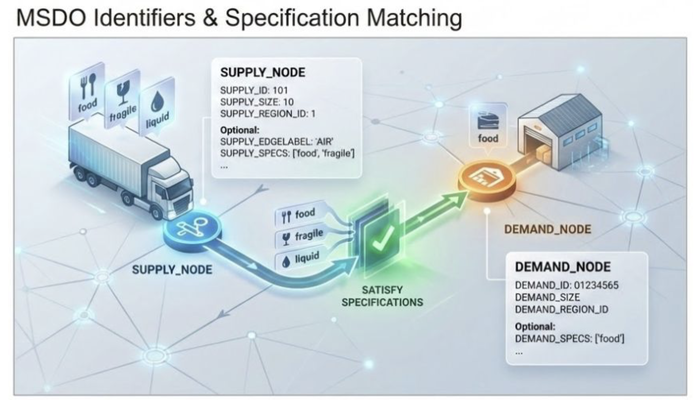
MSDO's specification-aware matching ensures that each demand is fulfilled only by supplies with compatible attributes like 'food-grade' 'fragile' or 'liquid handling' — enabling precise, real-world logistics routing directly within the solver.
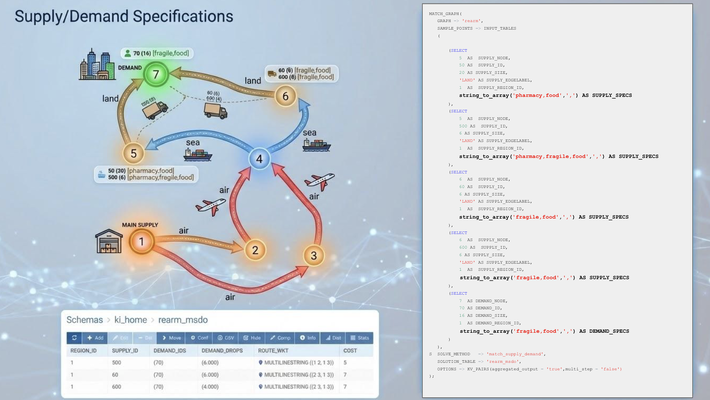
With supply and demand specifications defined directly in SQL, MSDO filters and routes only compatible goods reflecting real-world handling requirements across land, air, and sea.
3. Multi-Modal Routing as a First-Class Citizen
Lastly, in a global economy or in defense/military scenarios — an optimal route may need to include mode-specific constraints such as air, land, and sea. Our enhanced MSDO solver now supports multi-modal graphs with unique constraints like:
- Max stops
- Service limits
- Mode-specific path restrictions (cargo ship, rail, truck, or plane)
- Trip cost ceilings
- Round-trip vs. one-way toggles.
Each edge has labels, weights, penalties, max stops, radius limits, and more. This produces more accurate/efficient routes and dramatically simplifies operational and analytical workflows.
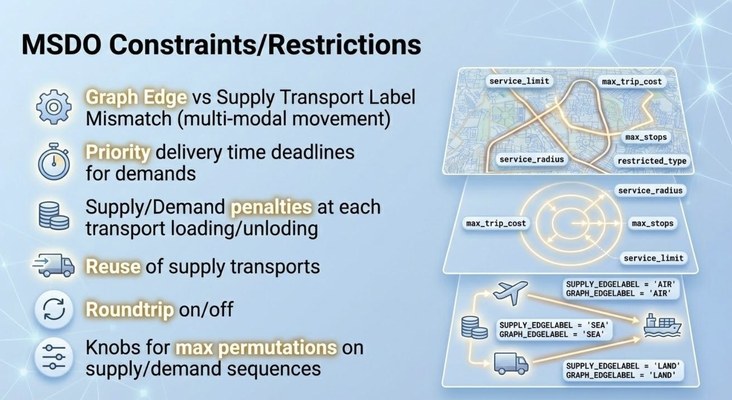
Real-world constraints from transport-mode matching and delivery priorities to penalties, reuse rules, round trips, and sequence permutations — enabling highly accurate multi-modal logistics optimizations.
This means MSDO can solve routing over realistic, multi-mode networks across the entire optimization, including constraints and transport labels. This gives organizations the ability to construct optimization closer to real world conditions, not abstract graphs — a core requirement for full-featured logistics engines.
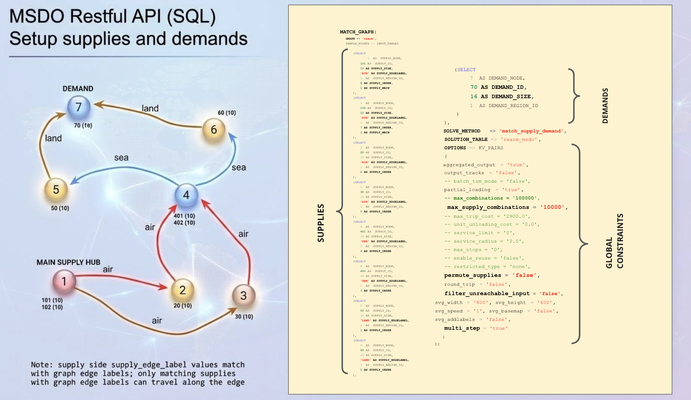
MSDO's RESTful SQL API lets you declare supplies, demands, and global constraints in one structured SQL call — automating multi-modal, multi-step logistics optimizations without external orchestration or custom code.
MSDO: No Longer Just a Solver
Whether you're coordinating regional hubs, managing inventory across distributed fulfillment centers, reacting to real-time demand variability, or building multimodal routing pipelines — MSDO now offers a powerful foundation for end-to-end optimization.
With multi-step planning, specification matching, and multi-modal routing combined, Kinetica's MSDO is rapidly becoming a next-generation logistics optimization engine that can:
- Solve multi-hop supply and demand relationships
- Respect SKU-level specifications
- Honor transportation mode constraints
- Model replenishment cycles
- Optimize cost across entire networks, not just isolated routes
- Scale across massive datasets (thanks to Kinetica's real-time engine)
In other words, we're moving from "an algorithm inside a database" to a true logistics intelligence layer.
This is logistics optimization reimagined — faster, cleaner, and easier to operationalize.