
This whitepaper presents a comparative performance evaluation of Kinetica 7.2.3.2 and ClickHouse 25.10.1 using the TPC-DS SF-100 benchmark. Both systems were tested on identical hardware configurations and loaded with the same dataset using the ClickHouse-referenced TPC-DS toolkit (page 2).
Key findings:
- Kinetica completed 100% of the 99 TPC-DS queries.
- ClickHouse completed 66% (single node) and 62% (two nodes).
- Kinetica delivered:
- 2.5× faster execution on shared completed queries (single node).
- 10× faster performance when full workload penalties were applied.
- 6.6× faster distributed execution (two nodes).
- 16× faster performance under distributed full-workload penalty conditions.
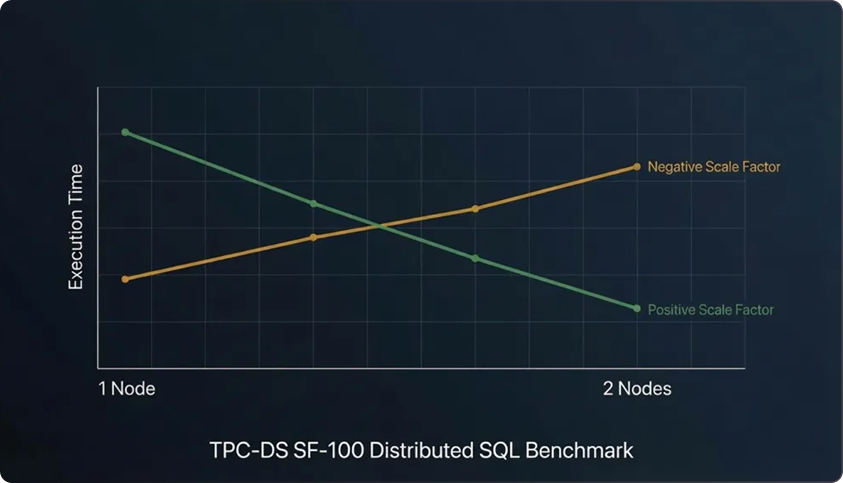
- Kinetica demonstrated positive scaling when moving from one to two nodes.
- ClickHouse exhibited a negative scale factor in distributed mode.
This study highlights the importance of workload completeness, distributed execution efficiency, and realistic benchmarking methodologies.
1. Introduction
Benchmarking analytical databases requires evaluating more than raw scan speed. Real enterprise workloads include:
- Multi-table joins
- Nested subqueries
- Window functions
- Complex aggregations
- Distributed coordination
- Memory-intensive execution plans
Microbenchmarks such as ClickBench focus primarily on simple aggregations and single-table scans. While useful for measuring raw vectorized scan throughput, they do not stress the optimizer and distributed coordination mechanisms required for complex analytical SQL workloads.
TPC-DS provides a broader and more realistic workload profile, including 99 diverse queries designed to simulate enterprise BI scenarios.
2. Test Environment and Methodology
2.1 Hardware Configuration
Both systems were tested on identical hardware
- 48 CPU cores (x86)
- 384 GB RAM
- 1 TB SSD
No GPUs were used in this benchmark

2.2 Software Versions

2.3 Dataset and Benchmark
- TPC-DS SF-100
- Queries sourced from ClickHouse’s referenced TPC-DS testing toolkit (page 2)
- Identical dataset loaded into both systems
2.4 Failure Penalty Formula
For incomplete workloads, a standard penalty was applied (page 4):


3. Single-Node Results
3.1 Query Completion


3.2 Shared Completed Queries (66 Queries)

Kinetica was approximately 2.5× faster
3.3 Full 99 Queries (Penalty Applied)

Kinetica was approximately 10× faster
4. Two-Node Distributed Results
4.1 Query Completion


4.2 Shared Completed Queries (62 Queries)

Kinetica was approximately 6.6× faster
4.3 Full 99 Queries (Penalty Applied)

Kinetica was approximately 16× faster
5. Distributed Scaling Behavior
The benchmark key findings (page 8) highlight:
- Kinetica scales and achieves faster run times as nodes are added.
- Query capability remains consistent across cluster sizes.
- ClickHouse exhibits a negative scale factor.
- Query capability degrades further in multi-node configurations.
5.1 Positive vs Negative Scale Factor
Positive scale factor:
Performance improves as resources are added.
Negative scale factor:
Performance degrades when moving from single-node to distributed execution.
In this benchmark:
- Kinetica improved performance moving from one to two nodes.
- ClickHouse execution time increased substantially under distributed workloads.
This suggests architectural differences in:
- Distributed join planning
- Data shuffle coordination
- Inter-node communication overhead
- Query optimizer stability
- Memory pressure handling across shards
6. Architectural Implications
6.1 SQL Completeness
Inability to complete complex queries forces:
- Query rewrites
- Logic fragmentation
- External preprocessing
- BI tool limitations
Completeness is foundational for enterprise reliability.
6.2 Distributed Query Planning
Efficient distributed execution requires:
- Deterministic parallelization
- Balanced data redistribution
- Minimized cross-node joins
- Stable memory allocation
- Efficient shuffle mechanisms
Negative scaling often indicates:
- Cross-shard join amplification
- Planner fragmentation
- Excessive network overhead
- Suboptimal aggregation pushdown
6.3 Benchmark Selection Matters
ClickBench primarily measures:
- Scan throughput
- Simple aggregations
- Columnar compression efficiency
TPC-DS measures:
- Complex SQL semantics
- Multi-way joins
- Window functions
- Nested subqueries
- Distributed coordination stability
For enterprise BI and operational analytics, TPC-DS provides a more representative workload.
7. GPU Acceleration Context
This benchmark did not utilize GPUs (page 8).
Kinetica can leverage GPU acceleration for additional performance gains. Therefore, results presented here reflect CPU-only execution performance and architectural efficiency independent of GPU acceleration.
8. Conclusion
This TPC-DS SF-100 evaluation demonstrates significant performance and capability differences between Kinetica and ClickHouse under identical hardware conditions.
Key conclusions:
- Kinetica completed 100% of TPC-DS queries across configurations.
- ClickHouse failed 33–37% of queries.
- Kinetica delivered:
- 2.5× faster performance on shared workloads (single node).
- 10× faster performance when full workloads were considered.
- 6.6× faster distributed performance.
- 16× faster distributed full-workload performance.
- Kinetica demonstrated positive scaling behavior.
- ClickHouse exhibited negative scaling characteristics.
For enterprises running complex analytical SQL workloads in distributed environments, query completeness and scaling stability are as important as raw scan speed.
TPC-DS exposes these architectural realities.
