
Scale without delay
The fund's risk platform had to process billions of JSON objects daily while ensuring every update was instantly queryable — without data loss or performance lag.
How a major hedge fund redefined real-time risk analytics — processing 5 billion JSON objects daily with sub-second latency and a radically simplified architecture.
Delivering real-time, scalable risk analytics across billions of daily data points.
The fund's risk platform had to process billions of JSON objects daily while ensuring every update was instantly queryable — without data loss or performance lag.
Each new risk metric required custom microservices, slowing development. The goal was to replace this complexity with a more agile, SQL-driven process.
As data volumes exploded, the system struggled to maintain performance. A new architecture was required to scale seamlessly under continuous growth.
Traders and analysts needed to run complex calculations against constantly changing datasets, demanding sub-second responses for better decision-making.
A microservice-heavy setup struggling to keep up with real-time financial data demands.
The platform relied on a large Cassandra cluster serving as a simple key lookup system, designed for high-volume data ingestion from Kafka reaching up to two million wide records per minute. Each analytical function existed as a standalone microservice containing its own processing logic. To support this, a large pool of application servers hosted the microservices, but the architecture quickly became complex and expensive to maintain.
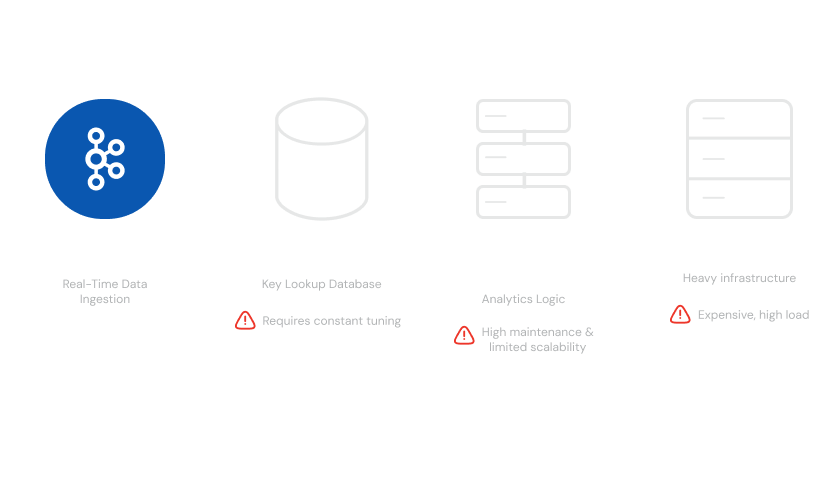
Data ingestion from Kafka into Cassandra required constant tuning to handle surges, creating operational overhead.
Microservices could only process small portions of data, restricting the scope and depth of real-time insights.
Every new metric demanded a new microservice, driving up maintenance and slowing innovation.
The need for heavy-weight nodes to host containerized microservices led to significant infrastructure spending.
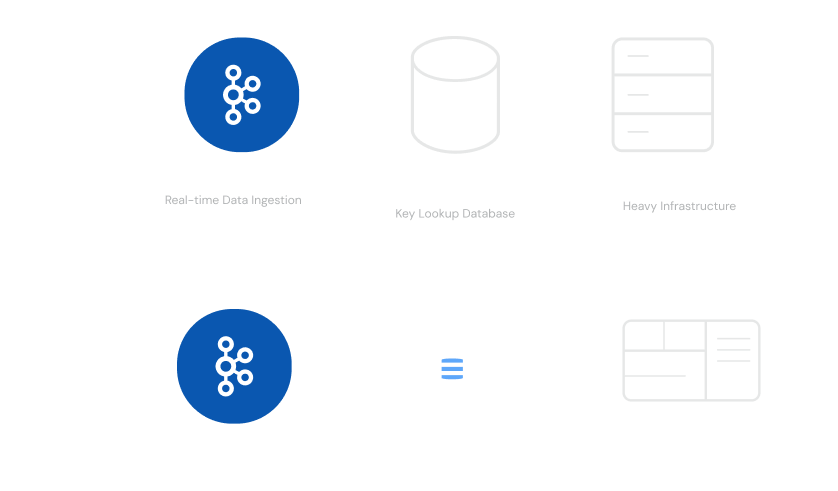
Unified ingestion and analytics with GPU-accelerated performance.
With Kinetica, the hedge fund achieved seamless, high-speed ingestion and analytics in one platform. Kinetica's native Kafka integration easily surpassed ingestion SLAs, averaging 1.3 million records per minute on a small AWS cluster. Complex queries could now run directly against live datasets, enabling analysts to generate richer, real-time insights.
Evaluated against modern analytical databases — ClickHouse, TimescaleDB, and StarRocks — on the fund's real ingestion and query workload.
| Capability | Kinetica | Other analytical databases |
|---|---|---|
| Ingestion speed |
1.3M+ records/min effortlessly
|
Unable to meet required ingestion speeds; slower than Cassandra
|
| Query performance during ingestion |
Sub-second latency
|
Poor, especially for complex queries with JOINs
|
| Kafka integration |
Native Kafka consumption supported
|
No native Kafka consumption capability
|
| Development overhead |
Simplified to SQL queries
|
Higher; often requires manual tuning or complex queries
|
| Infrastructure load |
Lean AWS footprint
|
Larger infrastructure footprint
|
| Monitoring effort |
Auto-optimized ingestion pipeline
|
Manual tuning often required
|
To provide the best experiences, we use technologies like cookies to store and/or access device information. Consenting to these technologies will allow us to process data such as browsing behavior or unique IDs on this site. Not consenting or withdrawing consent, may adversely affect certain features and functions. Cookie Policy