
NVIDIA’s next-generation CPU isn’t shipping until the second half of 2026. We got our hands on an early bring-up board anyway, pointed our open-source CoffeeBench benchmark at it, and ran it head-to-head against NVIDIA Grace and a 96-core AMD EPYC 9655P.
Vera won every single query. Every run. Every time.
What is Vera?
Vera is the custom Arm CPU NVIDIA is building around its own “Olympus” cores as the CPU half of the Vera Rubin platform — the successor to Grace Blackwell. Publicly disclosed specs put it at 88 cores across 176 threads, up to 1.5 TB of LPDDR5x memory, and roughly 1.2 TB/s of memory bandwidth, all connected to the Rubin GPU over coherent NVLink-C2C. NVIDIA has said production ramps in the second half of 2026.
The board we tested is early bring-up hardware — pre-launch, pre-production, configured with 128 GB of memory rather than the full 1.5 TB the platform supports. That matters: this is Vera on its worst day, and it’s still out in front.
The Benchmark: CoffeeBench
CoffeeBench is Kinetica’s open-source, one-click benchmark suite. It provisions Kinetica’s CPU-native database engine, loads a multi-hundred-million-row retail sales fact table joined against location and product dimensions, and runs 17 analytical SQL queries that mirror what a real retail analytics team actually asks:
- Rolling 7-, 30-, and 90-day sales averages
- Month-over-month product rankings
- Discount trend analysis by season and geography
- Quarter-over-quarter profit and margin decomposition with year-over-year comparisons
All of it is built on window functions and multi-way joins rather than simple aggregates. Each query runs three times in sequence:
- Run 1 — cold, near-cold execution
- Run 2 — benefits from warmed caches
- Run 3 — typically the fastest, fully warmed
This isn’t a GPU benchmark. Kinetica’s CPU-native engine ran identically on all three platforms — the only variable is the processor underneath it. The entire suite is public, so anyone can reproduce these numbers on their own hardware.
The Results
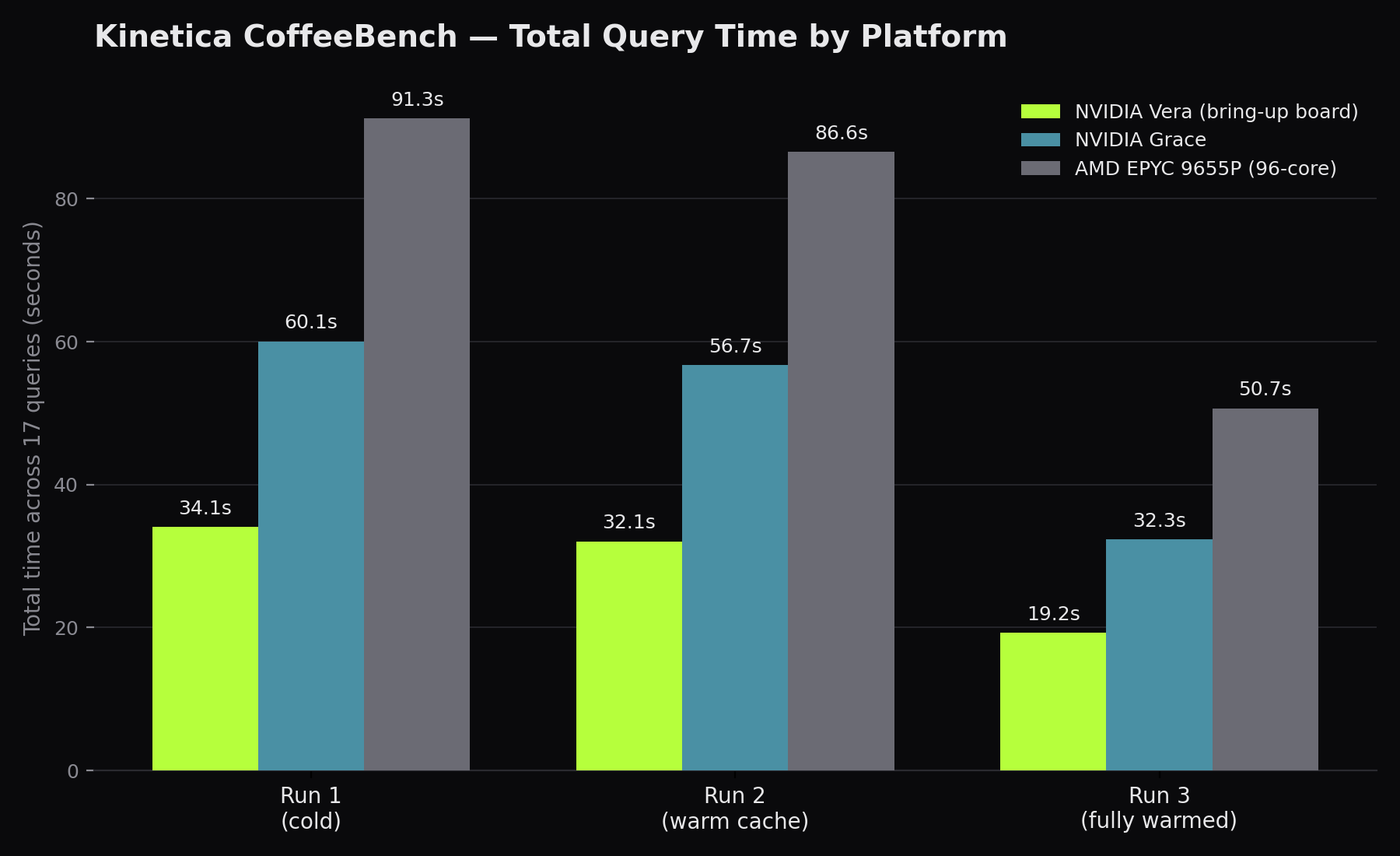
Summed across all 17 queries, here’s the total elapsed time on each platform, for each run:
| Platform | Run 1 (cold) | Run 2 (warm) | Run 3 (fully warmed) |
|---|---|---|---|
| NVIDIA Vera (bring-up board) | 34.1s | 32.1s | 19.2s |
| NVIDIA Grace | 60.1s | 56.7s | 32.3s |
| AMD EPYC 9655P (96-core) | 91.3s | 86.6s | 50.7s |
Lower is better. That works out to Vera running ~1.7× faster than Grace and ~2.6–2.7× faster than the EPYC 9655P, and the ratio holds steady whether the cache is cold or fully warmed. This isn’t one lucky query skewing the average — Vera beat both Grace and the EPYC chip on all 51 individual query/run measurements in the benchmark.
Standout Queries
A few results from the run are worth calling out on their own.
Query 16 — The Biggest Time Savings in the Suite
This query ranks the top-3 product categories by sales for every state and season, built on a three-way join across the sales, product, and location tables. It’s the heaviest query in the benchmark on every platform, and where Vera’s advantage shows up in real time, not just ratios: 18.1s total on Vera versus 48.8s on the EPYC 9655P — over 30 seconds saved on a single query. Even on the fully-warmed run, after every cache is hot, Vera still finishes 2.7× faster than EPYC and about 1.5× faster than Grace.
Query 10 — Where Warming Up Helps Vera the Most
A rolling 90-day distinct-order count per city, using an unbounded window function — normally one of the more punishing patterns for a query engine. Vera’s cold-start advantage over EPYC is already solid at 2.46×, but it actually widens to 2.86× once the cache is fully warmed. Grace and EPYC’s caching gains flatten out here; Vera’s keeps compounding.
Combined across all three runs:
| Platform | Query 10, Combined (3 Runs) |
|---|---|
| NVIDIA Vera (bring-up board) | 16.1s |
| NVIDIA Grace | 24.2s |
| AMD EPYC 9655P (96-core) | 42.8s |
Query 1 — The Sharpest Single-Run Gap
A rolling 7-day sales average by city — about as ordinary a retail analytics query as they come. On the very first, cold execution, Vera finished in 1.13s; EPYC took 4.35s. That’s a 3.86× gap, the largest ratio anywhere in the dataset, on a query type most teams run constantly.
Query 12 — The Honest Exception
Not every query was a blowout, and it’s worth saying so. This one had Vera’s smallest edge in the suite: on the cold run, Vera was only 1.32× faster than EPYC, and its margin over Grace briefly narrowed as Grace’s own warm-up curve caught up. Vera still won every measurement here too — the margin was just modest rather than dramatic.
Why This Is Worth Watching
Vera hasn’t launched yet. This is engineering sample silicon, configured well below its rated memory spec, run in isolation with no Rubin GPU in the loop — and it’s already outrunning a shipping Grace CPU and a current-generation 96-core EPYC processor on a real analytical workload. As Vera moves from bring-up to production hardware, there’s little reason to expect these numbers to get worse.
For teams planning next-generation infrastructure, that’s the headline: Kinetica’s engine is already extracting a substantial architectural advantage from Vera before the chip is even generally available.
Full benchmark suite, queries, and setup scripts: github.com/kineticadb/coffeeshop
More on the Kinetica + NVIDIA stack, including the Vera and Rubin early-access work: Kinetica + NVIDIA.
Want to run CoffeeBench against your own hardware? Try Kinetica free on Kinetica Cloud or download the Developer Edition.
Benchmark environment: single-node Kinetica CPU-native database engine, 17-query analytical workload over a joined fact/dimension retail dataset, three sequential runs per query (cold, warm, fully warmed). Vera figures reflect early bring-up hardware and are expected to improve at general availability.